Crime & Law
City Lawyers Fought — And Won — Lawsuit Filed by Man Shot Twice by Police. Taxpayers Still Paid $1.37M
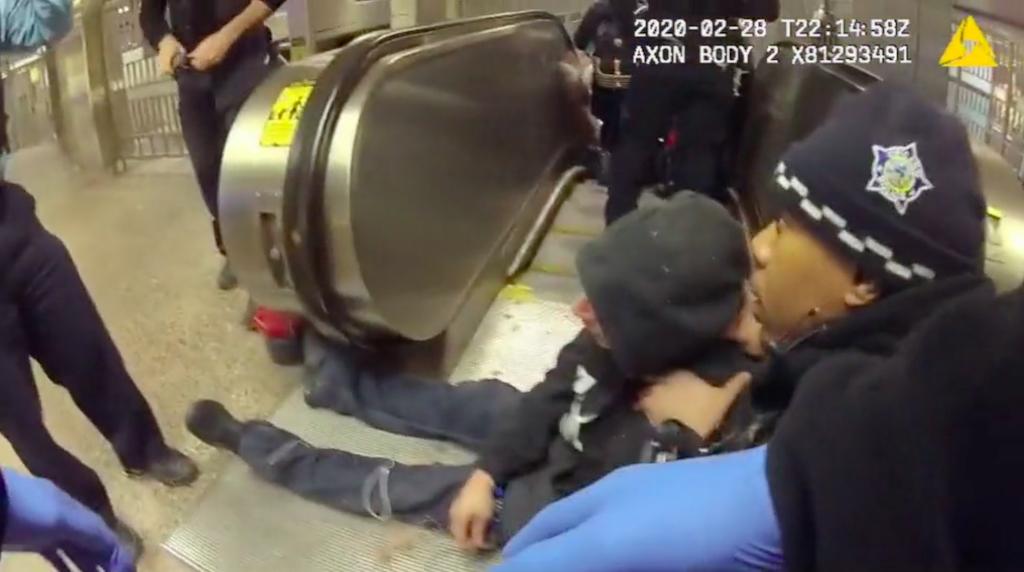 Chicago police officers respond to Ariel Roman, who is seated on the ground moments after he was shot inside the Grand Red Line station on Feb. 28, 2020. (Civilian Office of Police Accountability)
Lawyers for the city of Chicago convinced a federal jury in December that a police officer did not violate the civil rights of the unarmed man she shot twice during rush hour inside one of the busiest CTA Red Line train stations in February 2020.
But that victory, which came after a court fight that stretched for nearly six years, still cost Chicago taxpayers $1.37 million, according to records obtained by WTTW News through a Freedom of Information Act request.
Both former Mayor Lori Lightfoot and Mayor Brandon Johnson approved a request from the city’s top lawyer to hire private attorneys to defend Officer Melvina Bogard, and her partner, Officer Bernard Butler, records show.
In fact, the city hired four private law firms to defend the city and the two officers, even after Bogard faced criminal charges of aggravated battery and official misconduct for shooting Ariel Roman in the Grand Red Line station just after 4 p.m. on Feb. 28, 2020.
In addition, the Civilian Office of Police Accountability, the agency charged with investigating police misconduct, determined the shooting violated department policy and was unjustified. The agency better known as COPA urged that Bogard and Butler be fired, and former Supt. David Brown agreed.
A Cook County judge acquitted Bogard of those charges in November 2022. While Bogard resigned before she could be disciplined for shooting Roman, the Chicago Police Board voted 5-4 in August 2023 to suspend Butler for one year rather than fire him.
Borkan & Scahill earned nearly $600,000 for its work on the Roman case, records show. Nathan & Kamionski earned an additional $490,000 for its role in the lawsuit, while a third firm, Querry & Harrow, earned another $230,000, records show. A fourth firm, Mohan Groble Scolaro, earned approximately $55,000, records show.
Representatives of Borkan & Scahill, Nathan & Kamionski and Mohan Groble Scolaro did not respond to a request for comment from WTTW News. Querry & Harrow is no longer in business, ending operations in 2024, records show.
Roman’s lawsuit was halted while the COVID-19 pandemic shut down much of the federal civil court system, making the litigation especially expensive for the city.
The shooting, which was captured on video by onlookers and quickly went viral, took place just before officials ordered Chicagoans to stay home to stop the spread of COVID-19.
The incident began when the two officers ordered Roman off the train so they could cite him for crossing between cars while the train was moving, a violation of city ordinance. When Roman opened his backpack to get his identification, Butler grabbed his arm and a struggle began near the train tracks on a platform crowded with rush-hour commuters, according to the probe by COPA.
As the struggle continued, Butler moved Roman away from the tracks and Bogard discharged her Taser twice, according to the probe by COPA. Butler tackled Roman near the station’s escalator, and fired his Taser three times, according to the probe.
As Roman continued to resist, Bogard took out her pepper spray, which is also known as OC spray, and Butler yelled “shoot him.” Even though Roman’s face was inches away from her partner’s face, Bogard doused him with the chemical irritant, according to the probe.
Roman then got to his feet, prompting Bogard to unholster her weapon and say, “I’m going to shoot him,” according to the probe. Butler told her, again, to “shoot him,” according to the probe.
While attempting to clear the pepper spray from his eyes, Roman “staggered several feet toward” Bogard, who shot him in the abdomen, according to the probe. Wounded, Roman ran up the escalator, turning his back on both officers who pursued him, according to the probe.
Bogard fired a second time, striking Roman in the buttocks, according to the probe. Roman collapsed at the top of the stairs, where he was taken into custody, according to the probe. No one else was injured.
Roman was unarmed, and all of the charges against him were later dropped.
The city must provide or pay for lawyers to defend police officers accused of misconduct under the terms of the collective bargaining agreement with the Fraternal Order of Police, Lodge 7, the union that represents rank-and-file officers, approved by the Chicago City Council.
It is significantly more expensive for the city to hire private lawyers to defend lawsuits than to assign attorneys that work for the city’s Law Department to defend lawsuits like the one filed by Roman. But complicated lawsuits require a level of expertise that the city’s own lawyers don’t have, Corporation Counsel Mary Richardson-Lowry has told the City Council.
But that skill comes at a significant premium, costing Chicago taxpayers four to five times more than in-house lawyers, according to estimates offered during City Council budget hearings where these costs are a perennial sticking point for budget-conscious alderpeople.
The decision by the jury in December to find both officers and the city not liable for Roman’s injuries “was consistent with the Department of Law’s factual analysis of this case,” according to a statement from Kristen Cabanban on behalf of Richardson-Lowry.
“We owe a fiduciary duty to the taxpayer to assess each case carefully and determine the litigation strategy that protects the city’s legal and financial interests,” Cabanban said. “After extensive analysis, we concluded that trying the case is the most responsible path in defending and explaining why the officers’ actions taken against Mr. Roman were legally justified and reasonable under the law.”
The cost of defending and resolving police misconduct lawsuits has become a frequent source of political heartburn for members of the City Council, who are often divided along ideological lines about how to handle lawsuits that allege misconduct by police officers.
The city spent $34.7 million to pay private attorneys to defend lawsuits that alleged a wide range of police misconduct in 2024, records show. Those records are not yet available for 2025.
The Department of Law’s entire budget for 2024 was $46.4 million, according to the city’s spending plan.
Conservative alderpeople say the city’s lawyers and their colleagues are too eager to settle cases before trial. According to the alderpeople, that encourages those guilty of criminal wrongdoing to sue the city in the hopes of an easy payday.
Ald. Bill Conway (34th Ward), a former assistant state’s attorney who has been critical of the Law Department’s willingness to resolve police misconduct cases with large payments, told WTTW News he was pleased the city chose to fight the lawsuit.
But Conway, who ran unsuccessfully for Cook County state’s attorney in 2020 and is weighing a bid for mayor in 2027, visibly winced when WTTW News told him the court fight had cost nearly $1.4 million.
“I do think it is important that attorneys who sue the city don’t think we are simply going to roll over and settle every case,” Conway said.
It is impossible to know whether the city could have saved money by offering to settle the case by paying Roman less than what it ended up paying to the four private law firms, Conway said.
“Sometimes it’s important, and we have to go get outside counsel,” Conway said. “There’s a marginal cost and a marginal benefit to that. In complicated cases, I think it makes a lot of sense.”
Progressive members of the City Council see the financial toll of lawsuits alleging misconduct as perhaps the most visible cost of the fact that city officials have yet to put an end to the decades of scandals, misconduct and brutality that have engulfed the Chicago Police Department.
The City Council does not have the authority to determine which lawsuits are defended by private attorneys, in part because that would void the city’s attorney-client confidentiality privilege, a source of frustration for Ald. Raymond Lopez (15th Ward), who frequently criticizes the Law Department’s handling of police misconduct lawsuits and often votes against settlements.
The Law Department should have to demonstrate “a specific need” to hire private lawyers, especially since the Law Department has several hundred lawyers on staff, Lopez told WTTW News.
Lopez said the city’s frequent decision to hire private attorneys to defend officers amounts to a “pinstripe patronage system” that is especially frustrating because the Law Department’s budget increased by $2 million between 2025 and 2026 to $47.9 million.
“We should be using our attorneys to do this,” Lopez said. “The immediate knee-jerk reaction just to go to outside counsel is concerning to me.”
Lopez said the Law Department should establish a series of regulations that determine if, and when, private lawyers are hired.
“We don’t have any set of metrics that’s ever been explained to us,” Lopez said. “And we really have no control over what we’re getting billed for.”
WTTW News coverage of policing and police reform is supported by The Joyce Foundation.
Contact Heather Cherone: @HeatherCherone | (773) 569-1863 | [email protected]